
When Reason Breaks

by Cindy L. Rodriguez

Reviewed by SA

I am always nervous when I pick up YA novels (I say pretty much the same thing every time I start a review of a YA), as it is so hard to find a book that defies formula, breaks into new territory, and rips your heart out. Guess what? When Reason Breaks (Cindy L. Rodriguez) is most definitely a great novel. Plus, it’s a diverse book!
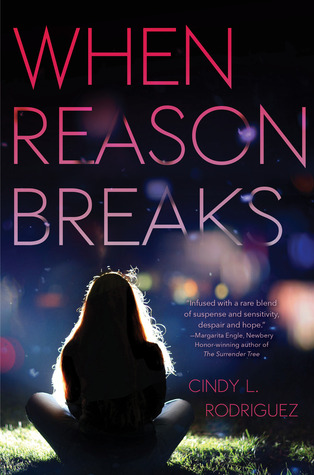
When Reason BreaksTwo sophomore girls come from different worlds. Emily is the sweet, smart daughter of a lawyer/politician father who controls most aspects of her life; she loves her friends Sarah and Abby, and her boyfriend, Kevin. Elizabeth is a dark goth girl whose father has recently run out on, making her the ‘basket case’ of the school, with anger issues and a tendency to draw dark pictures. When their English teacher, Ms. Diaz, places them together in class, they grow together over a love of Emily Dickinson, whose poetry will push them to reconsider many aspects of their lives.

The novel deals with the harsh topics of mental illness and suicide, while drawing parallels between the lives of the two young protagonists and Emily Dickinson herself. It will have your heart racing, your hands stuck to the cover, unable to put the book down.

Full disclosure; for the first half of the novel, I wasn’t convinced about if I liked it or not. I found the protagonists slightly pretentious, slightly predictable, and I felt as if I had seen them before. But as the plot progressed, I realized that the feeling of familiarity came from the fact that I did  know people just like them. I recognized their thoughts and feelings as those I had myself felt, or had experienced second hand as I stood alongside a friend through a tough time.

It was honestly the end of the third act (if you would want to call it that – you’ll know what I mean when you read it yourself) when the book grabbed me. The book begins with a dark chapter, after which the novel then takes you back eight months, to show what series of events has brought them to this point. Just like Ms. Diaz, I made assumptions about this moment; when I saw that I was wrong, my entire perception of the book shifted. My heart raced as I realized… “I am part of the problem,” a scary thought. I suddenly saw the novel in a different light; when I finally finished it, I had to put it down, stare at the ceiling, and think everything over in my head. Just… wow.

But what made it so much more interesting was the introduction of Emily Dickinson as the inspiration for the women. During the course of the book, the protagonist offer different interpretations to some of the most famous poems, making them their own. And after the novel ends, the author offers insight into the life of our favorite lady poet, showing us just how every character reflects part of her past. It’s fantastic how she is able to do this without making the book feel like a perfect replica of Dickinson’s life, or preachy in any way: it’s subtle.

It was an actual emotional roller coaster; it reminded me of Thirteen Reasons Why (Jay Asher), crossed over with The Breakfast Club. I recommend tissues!

When Reason Breaks comes out February 10th.

Oh look, a book trailer!

I Am Radar

22571542By Reif Larsen Reviewed by SA Stop everything and pre-order I Am Radar (Reif Larsen), because you can’t spend another second without having read this book. This novel is fantastic, and just might be my new favorite book – ever. I would like to say that it was as if Kurt Vonnegut wrote “Cloud Atlas”, but at the same time, it’s practically impossible to put the feeling I had reading this book into words.

Brief, spoiler free summary: In 1975, during a blackout, a boy is born coal black to a white couple, and the child is named Radar;  during the second world war, a group of Norwegian teachers create a society of artists and scientists that puts on radical performances in wartime; a man creates small puppet shows in black boxes in Serbia, so incredible you may think they are alive; and a child is found on a rubber plantation in Cambodia, his adoptive father deciding to raise him to be the greatest physicist the country has ever seen. Spanning decades and crossing the globe, I Am Radar takes you on an unforgettable journey, bridging art and science in an epic novel you will be unable to put down.

It’s a difficult plot to explain, because of how character driven this novel is. Just like Miro with his small black boxes, Larsen seems able to breathe life into his creations, giving every character incredible depth and dimension. I felt deeply connected to everyone I was introduced to, even minor characters, which made switching from one part (or perspective) to the next almost painful. Remarkably, the characters grow and change, a reminder that we are never the same person through our lives, and that life is unexpected, and will throw anything at us. Never before have a read a book where I was so aware of what made the characters tick.

To add to the realism, the author often ‘sources’ his facts, using photos, newspaper clippings, and other physical ‘evidence’ to support what his story. It blurred the line between fact and fiction, making me wonder where the truth ended and the story began. It makes the reader want to research for themselves, to see if any of these people really existed, or if the events ever happened.

But the best part of this novel for me was the melding or science and art. The artists use puppetry – think less muppet, more Royal de Luxe – to create both installation and performance pieces, using incredibly skilled techniques, pushing the limits of science to create beauty. These performances are told to us in such detail that we ourselves can imagine being there, and we can interpret these fictitious events for ourselves as true works of art, transcending the page. I wish I would have seen the ‘Conference of the Birds’ act for myself. I guess that’s why I came our of reading this book feeling the awe that I did: it was an incredible read, and I want to share it with everyone. I want to talk to my friends about the performances, as if they had actually happened, and what they would mean. I want to meet the author and say… Wow. 

I Am Radar comes out on February 25th.

Sarah’s 2014 Favorite – Station Eleven

by Emily St John Mandel
Reviewed by SA

I’m so late to this party. It’s the end of the year, and EVERYONE has done nothing but praise this new novel for the past few months. Best book of the year? Station Eleven sure is on a whole lot of people’s lists. And for good reason.

Post-Apocalypse novels seem almost overdone these days: somehow, civilization has fallen, the world as we know it is changed forever, and those who survive the initial cataclysm have a lot of adjustments to make. Picking up Station Eleven, Emily St John Mandel’s new novel, I was expecting more of the same; but I was pleasantly surprised.

So yes: civilization as we know it as ended. The Georgia flu, a viral pandemic of extraordinary proportions, kills off 99% of the planet’s population. We find ourselves twenty years later, following a troop of Shakespearian actors as they travel from settlement to settlement, working their magic on those of us who are left.

And it is beautiful.

StationelevenUKHCMany people have described Station Eleven as Mandel’s ‘Love letter to humanity’, and that is exactly the tone of the novel: civilization may have fallen, but we have gotten back on our feet, we still love and respect the good things, and we can adapt to new situations. The human race is adapting; newspapers are being written again, art is still being made, and people are still living. Even Shakespeare lives on.

The book divides itself between the world after the flu, following Kirsten, who was just a child when the world changed, as she performs and travels with the troop, and the days, months, and years before the pandemic, our present. The lives of the characters are intertwined around each other, sometimes in ways that seem far too coincidental to be believable, and the novel allows us to piece together the pieces as we go along.

Everyone seems somehow connected to Arthur Leander, a well know actor with a string of failed marriages. We follow his rise to fame; his many marriages; all the way to his final performance, which is actually where the book begins. We see Kirsten’s obsession with finding clues to Arthur’s life, and her attachment to the comic books, ‘Station Eleven’, whom no one seems to have ever heard of. We follow Jeevan, a paparazzi turned paramedic; Miranda, Arthur’s first wife, whose pet project seems to taint her relationships; Clark, Arthur’s older friend; and then there is this mysterious prophet, whom we don’t know too much about…

While the coincidences that connect the characters are sometimes too far fetched – I snorted aloud at more than one occasion – I thoroughly enjoyed how each of them were drawn out. These were characters with real dimension, that you began to care about and connect to, even if you were only with them for a short time.

There is just so much hope in this novel. It reflects a human race that deals with catastrophe with its chin up, and manages to make it through and survive through the most difficult trials. Some chapters begin by telling us the things that are gone, some making you close the book and pause to consider, but then they move on, showing that what remains is us, and we’re capable of so much more. The world has changed, but we’re still living, and we’re still acting.

Station Eleven is a fantastic read. The plot is captivating and enjoyable to follow, but the writing is what sells it. The beauty in the way Mandel describes the new world, and even in how she shows our current one. A book to be enjoyed and re-read over and over again.

One thing I found fantastic was the surprise page 305; if you purchased the ‘Picador’ edition, you will know what I mean.