Ivory and Bone

by Julie Esbaugh

I bought this book – pre-ordered it, in fact – manths back, when I heard about how it was a YA set in the prehistoric era. Woopee! Honestly the concept alone was what got me: I don’t think I know of any books like that, not what to expect from them. I went into this book knowing only one thing: we’ve travelled back to the age of the mammoth…

Summary

27064385

Hunting, gathering, and keeping his family safe—that’s the life seventeen-year-old Kol knows. Then bold, enigmatic Mya arrives from the south with her family, and Kol is captivated. He wants her to like and trust him, but any hopes of impressing her are ruined when he makes a careless—and nearly grave—mistake. However, there’s something more to Mya’s cool disdain…a history wrought with loss that comes to light when another clan arrives. With them is Lo, an enemy from Mya’s past who Mya swears has ulterior motives.
As Kol gets to know Lo, tensions between Mya and Lo escalate until violence erupts. Faced with shattering losses, Kol is forced to question every person he’s trusted. One thing is for sure: this was a war that Mya or Lo—Kol doesn’t know which—had been planning all along.

Musings

My first thought while reading this book was: wait, this is a little like Pride and Prejudice! And it turns out that’s what the author intended, I just avoided reading any blurb so as to avoid any spoilers, and didn’t see that until I was done. So I have to give cuddos for the author for having made that subtle enough to not be super evident,  but enough for the reader to catch.

However, this version of Pride and Prejudice is told with the genders reversed, and entirely in second person. The main character, Kol, is telling this story to you, Mya, for reasons that become apparent in the last third of the book. As of such, Kol is un unreliable narrator, because he just jumps to conclusions so quickly. Remind you of anyone?

Set in the Neolithic era (10,000-4,500 BC), we follow the lives of a hunter gatherer society. Kol’s clan is small, but they act as a unit, a family. They hunt mammoth and seal together, one of his brothers is a musician, they have art,  basic medicine, and lead rather happy lives. Their interaction with other clans is limited, so when they meet their neighbors to the south, they’re desperate to get along. But their past is not easily put behind them.

One of the main things people fault with this novel is just how this all revolves around misunderstandings. Why don’t people just come out and say what they mean? Honestly that’s something that bothered me in the original P&P, so i think it’s an excusable plot point here.

While the pacing is slow until the last third, I quite liked the world building, and it didn’t stop the novel from being a fast read. It felt incredibly immersive, and the author has a style that’s really evocative. It played on the senses, making me see and feel the things that were there.

Now there was a bit more romance than I was into, but it was really well done. Kol and Mya’s relationship mirrors that of Darcy and Elizabeth, only with the genders reversed. Mya is a mystery, and we’re excited to learn more about her. And this is far from being a traditional take on a love story – I mean, we’re 12,000 years before the regency period, so life is a little different: a little more equal, a little less homophobic, and with a whole lot more hunting.

All in all, a very good read. I enjoyed being brought into the story, and will very likely read it again, knowing what I know now. A great piece of YA fiction.

The Masked City

By Genevieve Cogman

Well this is embarrassing! I read this book on the plane a few months back and completely forgot to review it, even though I loved it. So I reread it yesterday to give it the attention it deserves, right before I read the third book and share it with you. Oops!

Librarian Spies. Alternate realities. Dragons, Fae, and high technology. Heck yes, I absolutely love the universe Cogman has created in the Invisible Library series. We reviewed the first one not too long ago and I admit, I could not shut up about it (and still can’t!).  So, needless to say, I was excited to return to it as fast as I could. She did not disappoint: The Masked City – a direct sequel to The Invisible Library – was fun and exciting, a fast read I could not put down.

Summary28186364

Librarian-spy Irene is working undercover in an alternative London when her assistant Kai goes missing. She discovers he’s been kidnapped by the fae faction and the repercussions could be fatal. Not just for Kai, but for whole worlds.

Kai’s dragon heritage means he has powerful allies, but also powerful enemies in the form of the fae. With this act of aggression, the fae are determined to trigger a war between their people – and the forces of order and chaos themselves.

Irene’s mission to save Kai and avert Armageddon will take her to a dark, alternate Venice where it’s always Carnival. Here Irene will be forced to blackmail, fast talk, and fight. Or face death.

Musings

We return to the beloved characters of Irene and Kai, as they continue their work in the slightly Chaotic London. Irene, as Librarian in residence, has a lot of responsibility, but has begun making friends, and continues to train Kai as her apprentice, keeping his Dragon heritage a secret. I was afraid we would be ‘stuck’ in this universe, since Irene was assigned to it, and wondered how the author could make it exciting, but trust me, we do not stay there long. That London has already told its story, and we’re going on a thrill ride threw new and exciting alternates, ramping up the excitement from the last book.

Kai’s been kidnapped, and it’s up to Irene to find him before the Dragons declare war on the chaotic worlds, or the Fae declare war on the dragons – whichever comes first. With the balance of the universe at stake, Irene has very little time, and very little help. While she continues with the support of both Kai’s uncle, Ao Shun, a powerful noble dragon, and of the library, she’s still alone and running head first into a chaotic universe. There’s going to be danger.

It’s so evident this novel was written by a book lover. While in the first novel we were introduced to the Library, an institution that collects and stores the most important works across all alternate universes, the sequel delves into the world of Fae, who feed off the drama they create amongst humans. Their lives revolve around story: how exciting is theirs? Irene is dragged in and out of the stories of so many Fae, making it near impossible to save Kai, though exciting to say the least. The care and importance Cogman gives to the love of Narrative really shows in her own work as well as the lives of the characters she creates. It’s a clever way of putting stories within stories.

And I just adore the locations. The Venice Irene visits is a perfect version of the place, like the stories you hear from friends: it’s always carnival, everyone’s in beautiful masks and riding gondolas around the city from expensive palace to cozy taverns. The High tech home of Kai, and the sudden trip to Marseille (mah home!) made me giddy and excited. And the Train… oh my gosh, the Train deserves its own book.

One thing I still don’t really like (same as in the first book) is just how much talk there is. Just in the sense that Irene has to talk out all of her ideas with others, going through every possible question and answering them. “Why did you do this?” “Why wouldn’t you do that?” etc gets tedious, and you wonder why she won’t just get on with it. As a reader, I can determine a lot for myself, and sometimes, it’s just better to move on. It’s just a stylistic choice I don’t really like, but it doesn’t make the book any less enjoyable.

But gosh, this is a fun series. The ending is a sharp cliffhanger and I’m so excited to read the next one ASAP. I love this universe, and I can’t believe more people aren’t talking about it!

Angel Eclipsed

by C.L Coffey

Sorry folks that I haven’t been reviewing as frequently as I’d like to! Midterms have been popping up left and right and it’s all I can do to keep up. Luckily, the amazing C.L. Coffey sent me the sequels to Angel in Training (which I reviewed not too long ago, here) and they offered a well needed break from my insanity here. Angel Eclipsed is a fantastic sequel to a fantastic book, and I can’t wait to tell you about it!

26088931Summary

Six weeks ago, Angel earned her wings. Six weeks ago, Angel killed an innocent person. Six weeks ago, Angel set Lucifer free.

Michael doesn’t accept that Lucifer is alive, let alone free, and he should know – he was the one to kill him. Thankfully, Veronica and the cherubim are on her side, only they seem more interested in proving Michael wrong than helping put Lucifer back in hell.

Then there’s Joshua. Angel is convinced that the best way for her charge to stay alive is for her to stay away. The problem is that Michael is adamant she remain his guardian angel.

Can Angel keep her charge and New Orleans safe from the evil that is lurking, or will her own demons be their downfall?

Musings

It’s been six weeks since the events of book 1, and Angel is spiraling out of control. Depressed and mentally stuck in the moment she killed Lilah, she hasn’t eaten or slept, or even left her room for that matter. But when Joshua radio flares up, she forces herself up out of the house and back to save her charge. Step one was getting out of her room: step two is coming to terms with what she did.

The author didn’t skimp on the pain that accompanies guilt. Angel is truly suffering, with PTSD on top of her angelic guilt. So it’s not that easy, with all that on your shoulders, to try and convince the people around you that Lucifer has risen. Michael refuses to believe her, which just makes everything worse. Angel might have earned her wings, but she has yet to earn his trust – and him, hers.

Angel is now leading her own investigation into the unsettling club, “Bee’s,” that had taken up so much of her focus in the first book. But she’s not entirely alone: Veronica the cherub might be the only one who believes her about Lucifer rising, and she’s determined to prove it. With Joshua by her side, and a few new allies, the stakeout begins.

The novel focuses more on Angel’s growing relationship with her charge, Joshua. They both have definite feelings for each other, but everything is banned by Michael. A bit of “will they, won’t they” spices up the novel, as Angel tries to balance her work life and potential love life.

The only fault I could give this novel was that the pacing was off. The novel was pretty slow for the most part, without anything really happening until the last fifty or so pages: but dang, what an ending! I was so excited as the pieces fell into place, and I can’t wait for more. THAT ENDING! Luckily I have the third book to look forward to!

Also – I love the little jokes about Supernatural! fun little easter eggs for the reader. If you like the show, then you’d definitely love the Lousiangel series.

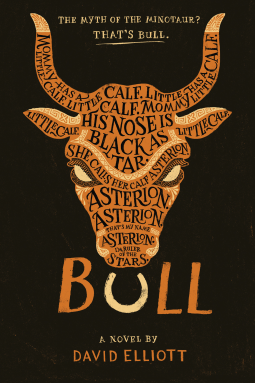
Bull

by David Elliot

Much like this book, my review will be short and sweet. With studying insanity, I have’t have much time to read, but when a book in verse showed up about the myth of the minotaur, I knew I had found my latest obsession.

cover100021-mediumSummary

SEE THE STORY OF THESEUS AND THE MINOTAUR
IN A WHOLE NEW LIGHT
 
Minos thought he could
Pull a fast one
On me,
Poseidon!
God of the Sea!
But I’m the last one
On whom you
Should try such a thing.
The nerve of that guy.
The balls. The audacity.
I AM THE OCEAN!
I got capacity!
Depths! Darkness! Delphic power!
So his sweet little plan
Went big-time sour
And his wife had a son
Born with horns and a muzzle
Who ended up
In an underground puzzle.
What is it with you mortals?
You just can’t seem to learn:
If you play with fire, babies,
You’re gonna get burned.
  
Much like Lin-Manuel Miranda did in Hamilton, the New York Times best-selling author David Elliott turns a classic on its head in form and approach, updating the timeless story of Theseus and the Minotaur for a new generation. A rough, rowdy, and darkly comedic young adult retelling in verse, Bull will have readers reevaluating one of mythology’s most infamous monsters.   

Musings

This is definitely a different view of the classic story thank you’ve ever seen before: the tale of the minotaur, from every character’s point of view, narrated by Poseidon, all entirely through verse. A musical minotaur bonanza. Boo-yeah!

I was laughing out loud as I read this book, which was short and probably took me no more than an hour to get through. I’m planning on going back through it again, combing it for details I missed the first time. So many little allusions to other classic myths!

Every character had a different voice and perspective. It was interesting reading the author’s note after the fact, describing each characters’ person verse. The author played not only with the poetic styles, but also with the form, and even took advantage of the page itself! Let me explain: as the minotaur’s character loses himself more to the bull, the pages become darker and darker until they’re entirely black. His verse will form a jagged line on the page. As his mother Pasiphae starts losing her mind, her lines become hectic, nonsensical.

My gosh, it was so clever! I think this is going to thrill english teachers everywhere, because this is a book you can seriously enjoy tearing into the details of. Lots of fun, very funny, with darkness too. Would be awesome to see performed on stage.

The Bear and the Nightingale

by Katherine Arden

You know how some books can really put you under their spell? Make you unable to put them down, fully dragging you into the narrative, so deep you forget to come up for air? The Bear and the Nightingale has that kind of pure, raw magic to it. Before I was even halfway through this book, I knew I needed the hardcover.

Summary25489134

A young woman’s family is threatened by forces both real and fantastical in this debut novel inspired by Russian fairy tales.

In a village at the edge of the wilderness of northern Russia, where the winds blow cold and the snow falls many months of the year, a stranger with piercing blue eyes presents a new father with a gift – a precious jewel on a delicate chain, intended for his young daughter. Uncertain of its meaning, Pytor hides the gift away and Vasya grows up a wild, willful girl, to the chagrin of her family. But when mysterious forces threaten the happiness of their village, Vasya discovers that, armed only with the necklace, she may be the only one who can keep the darkness at bay.

Musings

It’s hard to pinpoint exactly what made me love this book so much. I think, first of all, the storytelling quality it has to it. The style has that folktale feel to it, even though it’s much more complex than the kind of story you would be told around the fire on a cold winter’s night. The fact that it manages to tell tales while being a tale itself really made me enjoy it even more.

Maybe that’s why it was so engrossing. The way I could be pulled into the stories inside the story. The way it made me feel the snow and the cold, to wish there was a fire beside me. The way it shared Russian mythology with me, while turning these folk characters into ‘real’ people, with complex problems and motivations.

Vasya is a firecracker. She grows up playing in the woods, befriending the spirits there. She learns to speak with the horses, and they teach her to ride. She gives up her food and her own blood to those who protect her, and she protects in return. But this kind of action has her labeled as a witch, a wild child who will never be able to hold down a husband. She is very much a modern girl in this tale, even though she is the only one to believe the old stories as everyone else moves on. She bold, strong, and caring, and overall fiercely loyal, all without coming off as annoying. A brilliant character whom I loved.

Overlaying this on a landscape and a time period where the only options for a woman are matrimony or the convent, Vasya struggles to find her place. Well, I should say, other have a hard time placing Vasya: Vasya knows what she wants.

The major theme here at play seems to be the first of old tales versus new beliefs. As christianity is brought – or, I should say, enforced – into the small villages, the old beliefs are swept aside, and the spirits are fading. No wonder people think Vasya is a witch. The priest, Konstantin, sees he child as the enemy, someone trying to undo gods work, trying to tempt him. The fight of old versus new grows, as an old threat returns. Pretty bad timing for a priest.

A few minor things ticked me off, like how Vasya’s growth into a woman was handled – some of the comparisons were a little creepy, as well as the looks of men. That, and I’m not quite sure about the Nightingale in the title, since it only shows up towards the end. I assumed Vasya would be the nightingale: maybe it’s a metaphor that flew over my head (pun not intended.)

Another little detail – that’s mainly my own problem! – was that, to respect the Russian culture and spelling, a lot of the character has multiple names. Their first names, nicknames, nicknames built off nicknames… a little confusing as there were so many. Again, my own issue.

All in all, this is a fantastic, beautiful book. It reminds me of Uprooted, by Naomi Novik,  which I also adored this year, but with some of the themes Neil Gaiman loves to write. So if you love either of them, you’re going to devour the Bear and the Nightingale. Out January 10th.


After Atlas

by Emma Newman

I was having quite a bad day when this book showed up on my doorstep, completely out of the blue, like a gift from the universe. I had never read Planetfall, but had heard great things about it, so you can imagine I was pretty stoked to get After Atlas, which is set in the same universe, but not exactly a sequel so I could actually jump right into it. Well, I dove. And the trip was insane.

Summary28361265

Govcorp detective Carlos Moreno was only a baby when Atlas left Earth to seek truth among the stars. But in that moment, the course of Carlos’s entire life changed. Atlas is what took his mother away; what made his father lose hope; what led Alejandro Casales, leader of the religious cult known as the Circle, to his door. And now, on the eve of the fortieth anniversary of Atlas’s departure, it’s got something to do why Casales was found dead in his hotel room—and why Carlos is the man in charge of the investigation.

To figure out who killed one of the most powerful men on Earth, Carlos is supposed to put aside his personal history. But the deeper he delves into the case, the more he realizes that escaping the past is not so easy. There’s more to Casales’s death than meets the eye, and something much more sinister to the legacy of Atlas than anyone realizes…

Carlos – or Carl, for short – is a detective for Norope’s ministry of Justice, serving out a fifty year contract before he can be free. Only a baby when Atlas took off with his mother, the media’s been on his back for years trying to get him to talk about how it feels to be abandoned like that. His past is murky, and filled in in small increments as he leads the investigation into the murder of Casales. He has a history with Alejandro: his father brought him into the Circle, the cult Alejandro leads, and Carl might be the only person to have ever gotten away. He’s determined to solve the murder.

There’s two aspects of this novel running in parallel: the story of Carlos, a detective solving a case, and the story of Earth, in shambles after Atlas left. This future earth is both a backdrop and a major player in the story, a complex society where everything is managed digitally, real food is a delicacy and actual privacy is worth all the money you have. Usually, when you have two narratives side by side, one is likely to overshadow the other, but here I was impressed that both were so compelling. I both had to know how the murder when down, and also wanted to stay longer in this word, exploring the complexities that Newman has conjured onto the page.

The ending, which ties in with Planetfall, was brilliant, but I am sure I would have enjoyed it even more if I had read Newman’s first book. I still enjoyed the novel as a separate piece, but now I’m desperate to read the first one so I can see the hints the author dropped along the way… while at the same time being completely crushed by the twists. So cruel!

I really have to thank Roc for sending me this book. It releases next week on Tuesday the 8th of November.