
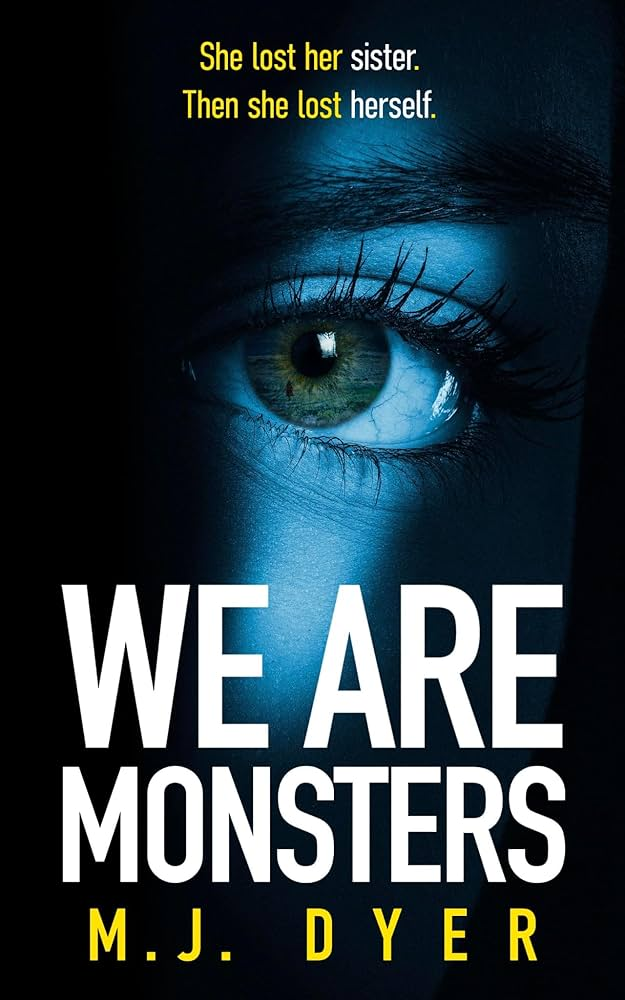
She lost her sister. Then she lost herself.
We Are Monsters by M.J. Dyer is one of those books that creeps up on you. At first, I thought I knew what kind of story I was stepping into: dark academia, dead sister, suspicious family, probably some secrets buried out on the moors. You know. The usual healthy reading choices.
But this book is not quite so simple. It’s twisty, claustrophobic, deeply character-driven, and increasingly uncomfortable in a way that really worked for me.
Blurb
Welcome to St. Margaret’s University, a campus on Bodmin Moor where sibling rivalry has never been more dangerous…
Elara has always been jealous of her beautiful sisters, identical twins Astrid and Halley. Astrid is the loud, scary, dominant one, and Halley is the kind, gentle, soft one. Next to them, Elara is invisible, bland, boring. And she is always compared to them. Just once, Elara wants to force people to notice her and make her sisters pale in comparison.
When Halley’s body is found on the moors, Elara has the perfect opportunity to step into the spotlight. The police have ruled Halley’s death a tragic accident, but Elara is sure it was murder, and she’s going to make sure everyone knows this and notices her—even if it means putting herself in the killer’s sights. Or worse.
My Thoughts
At first glance, We Are Monsters might seem like a fairly straightforward psychological thriller: a university on Bodmin Moor, a dead sister, and a narrator convinced there is more to the story than everyone else wants to admit. But the deeper I got into this book, the more I realized M.J. Dyer was doing something far messier, sharper, and more unsettling.
The story follows Elara, the forgotten third “sister” in a family dominated by her cousins, identical twins Astrid and Halley. Astrid is loud, frightening, and impossible to ignore. Halley is soft, gentle, and beloved. And Elara? Elara has spent her life feeling invisible beside them. When Halley’s body is found on the moors, and her death is ruled an accident, Elara becomes convinced it was murder. And yes, part of her wants justice. But part of her also wants, maybe for the first time in her life, to be seen.
That’s what makes Elara such a compelling narrator. She is jealous, obsessive, wounded, and not always honest with herself or with us. She is unreliable, but not in a gimmicky way. Instead, her unreliability pulls you deeper into her unraveling world. You can feel how badly she wants to matter, how desperate she is to prove that something is wrong, and how tangled that desire becomes with grief, resentment, and old family wounds.
I loved how alive and human the characters felt. Nobody here is clean or simple. The “monsters” of the title are not necessarily obvious, external threats. Sometimes they are the things that grow inside us over time: jealousy, obsession, bitterness, the need to be loved better than we were.
The family dynamics were one of my favorite parts of the book. The setup alone is fascinating: identical twins, and then the extra sister, genetically just as much their sibling as they are each other, despite being their cousin (it’s a complicated, messy family), but emotionally always the third wheel. Elara’s place in the family feels painfully specific. She is not unloved in some obvious, dramatic way. Instead, she is compared, overshadowed, and diminished until invisibility becomes part of who she is. Or, at least, from her point of view.
There is also the weight of legacy and appearance. Outside the trio of sisters, the wider family bonds feel murky in a way that seems very intentional. It often feels like keeping up the appearance of being a family matters more than actually being one. Which, frankly, is its own kind of horror.
The setting is perfect. Bodmin Moor gives the whole book this oppressive, breathless quality. Whether the characters are inside the university or out on the moors, nothing ever feels safe. The darkness is not just outside. It seeps into the buildings, the family history, the relationships, and eventually Elara herself. The whole book feels like a net tightening.
I also really appreciated the representation. The chronic illness and disability rep, specifically Ehlers-Danlos syndrome, felt thoughtful and well-integrated. The asexuality rep was also strong. What I liked most is that these elements are not treated as the entire point of the story, but they are central to the characters. They feel lived in, not pasted on.
My only real hesitation is that, at times, the characters read younger than university students. I occasionally had to remind myself this was set at a university rather than a high school. It didn’t ruin the book for me, but it did create a little distance now and then.
Still, We Are Monsters really got under my skin. It’s tense, intimate, and unsettling, with messy sister dynamics, an oppressive setting, and a narrator you can’t quite trust but can’t look away from either.
If you enjoy psychological thrillers with complicated family relationships, unreliable narration, chronic unease, and a strong sister/twin focus, this one is absolutely worth picking up.
We Are Monsters is out today from Ineja Press.

